
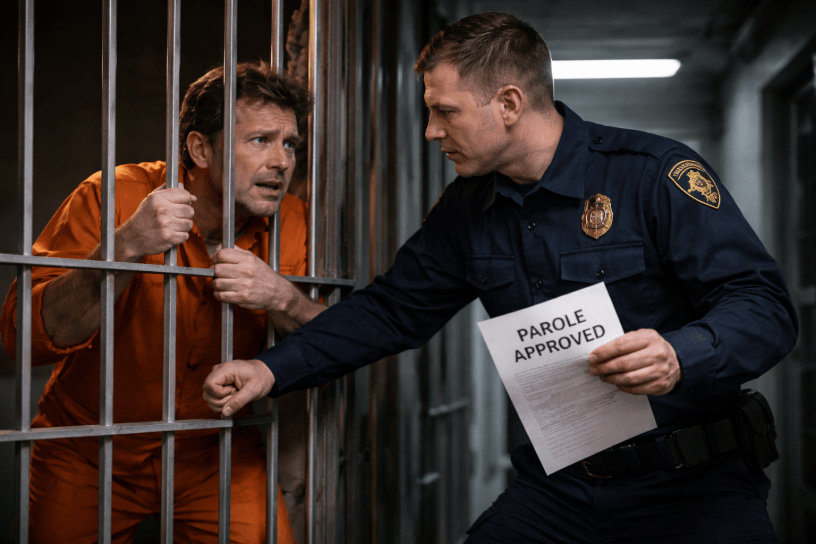
There are a lot of stories that circulate inside the Idaho Department of Correction. Some are exaggerated. Some are half-true. Some are prison mythology. But one story has been told so many times that nearly everyone who has spent time in IDOC has heard it.
It is the story of Dick Gavel.
Whether Dick Gavel was a real inmate or simply a legendary character that evolved through decades of prison storytelling is hard to prove. But the story itself captures something that many prisoners say reflects reality. According to prison lore, Gavel had been serving a lengthy sentence when he became eligible for parole. At the time, Idaho prisons were overcrowded and the parole board was looking for candidates they could justify releasing.
Gavel went into his parole hearing knowing exactly what he wanted. He wanted to finish his sentence inside prison.
The story goes that when the parole board started talking about releasing him anyway, Gavel stood up, dropped his pants, and banged his anatomy on the table like a gavel. He then yelled: “I don’t want to be released! I want to top out!”
The room went silent.
Whether the event actually happened exactly like that is impossible to confirm. But the reason that story continues to circulate through Idaho prisons says something important. Many inmates regularly admit they would rather serve their entire sentence inside prison than risk parole. The reason is simple. They believe Idaho’s parole system is stacked against them from the start.
Parole and the Reality of Technical Violations
In theory, parole exists to help prisoners transition back into society while remaining under supervision. In practice, parole often becomes something very different. Many people are returned to prison not because they committed a new crime, but because they violated a rule of supervision. These are known as technical violations.
A technical violation occurs when someone on parole breaks a supervision rule that is not itself a criminal offense. Examples include:
- Missing a meeting with a parole officer
- Violating a curfew
- Using an unapproved phone or computer
- Traveling outside an approved area
- Entering an unapproved relationship
Across the country, criminal justice reform advocates and policymakers have increasingly recognized that returning people to prison for technical violations does little to improve public safety.
In fact, it often does the opposite by disrupting employment, housing, and stability. Many states have started reforming their parole systems to reduce incarceration for technical violations.
Idaho has largely not followed that trend.
Idaho’s Numbers Raise a Serious Question
Idaho’s statistics raise a hard question that the political class rarely seems eager to answer. Idaho is not a high-violent-crime state. In 2024, Idaho recorded 231 violent crimes per 100,000 people. Utah — right next door — recorded essentially the same rate: 230 per 100,000.
If violent crime were the primary driver of incarceration policy, you would expect Idaho and Utah to have similar correctional populations. They do not.
At year-end 2023:
- Idaho had 2,673 adults per 100,000 people under community supervision
- Utah had 754 per 100,000 people under community supervision
That is not a small difference. That is a three-fold gap.
The incarceration numbers tell the same story.
Idaho’s incarceration rate was listed at 720 per 100,000 residents.
Utah’s was 396 per 100,000.
So the obvious question becomes unavoidable:
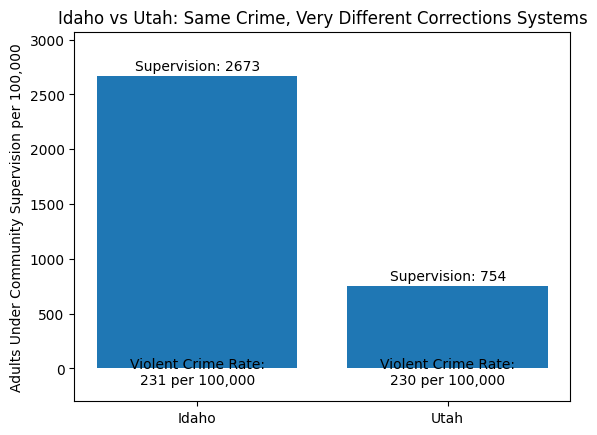
If Idaho and Utah experience nearly identical violent-crime rates, why does Idaho keep so many more people under correctional supervision and behind bars?
Idaho’s Parole Conditions
One very reasonable explanation can be found in the conditions that Idaho imposes on parolees. A real example of parole conditions issued by the Idaho Commission of Pardons and Parole provides a glimpse into how the system works. Some of the restrictions sound reasonable, where as others, when compounded, make compliance nearly impossible.
Among the requirements listed in the document are conditions that the parolee:
• Remain drug and alcohol free
• Avoid establishments where alcohol is the primary business
• Follow a treatment aftercare plan
• Complete anger-management programs
• Complete a domestic-violence class
• Obtain a mental-health evaluation
• Take prescribed medications
• Maintain lawful employment
• Receive permission before changing employment or residence
• Avoid associating with known felons
• Submit to searches and chemical testing
Perhaps most striking is the transportation restriction.
The parolee is told: “Do not drive, do not have a driver’s license, and do not have a vehicle registered in your name.”
The document also states that no driving is allowed for the first three years of parole. Now consider that rule in the context of Idaho geography. Idaho is a rural state with limited public transportation. Many communities have no public transit at all. Yet parolees are expected to:
• Attend treatment programs
• Meet with parole officers
• Maintain employment
• Comply with curfews
• Attend classes such as anger management or domestic-violence counseling
All without driving. At some point, this begins to resemble less a structured reentry program and more a bureaucratic scavenger hunt.
The Jeffrey Lynn Case
A real example illustrates how this system can operate in practice.
In November 2023, the Idaho Department of Correction issued an Agent’s Warrant for parole violations involving Jeffrey Stephen Lynn.
The warrant lists several alleged violations:
- Unapproved relationship and sexual contact
- Unauthorized travel outside the State of Idaho
- Use of an unapproved electronic device with internet access
- Curfew violation
None of these allegations involve a new criminal conviction. They are technical violations. The allegation regarding an “unapproved relationship” reportedly stemmed from a failed polygraph test, not a criminal charge.
The travel violation highlights another practical problem. Lynn lives in Sandpoint, Idaho, in the narrow northern panhandle of the state. In some areas, the Idaho panhandle is only about 45 miles wide. The nearest major medical services — including many 24-hour urgent care facilities — are located in Spokane, Washington, just across the state line. Traveling there without explicit permission could technically violate parole. Again, none of these allegations involve new criminal behavior. Yet technical violations like these can quickly lead to incarceration.
What the Courts Have Said About Parole Revocation
The law in other jurisdictions increasingly recognizes that supervision cannot be treated like a booby-trapped obstacle course where any misstep sends a person back to prison.
In Morrissey v. Brewer, the United States Supreme Court ruled that parole revocation is not simply the cancellation of a minor privilege. It is the loss of a real liberty interest, meaning due process protections apply. In simple terms, once the state allows someone back into society, it cannot casually take that liberty away without fair procedures.
The Court reinforced this principle in Black v. Romano, emphasizing that revocation should not be automatic and that authorities must consider alternatives before incarcerating someone for a violation. Federal appellate courts have echoed similar concerns.
The Eighth Circuit has stated that revocation should not be a “reflexive reaction to an accumulation of technical violations”, and that supervision should only be revoked when a person’s conduct demonstrates they cannot avoid antisocial behavior. In other words, missing technical checkboxes should not automatically equal incarceration.
State courts have gone even further. Florida courts have repeatedly held that probation violations must be “willful and substantial” before revocation is justified. In Angel Steven Delarosa v. State, the court ruled that probation officers cannot create unofficial conditions and then use those conditions as the basis for revocation.
Other states have implemented legislative reforms. Pennsylvania law now includes a presumption against full incarceration for technical probation violations, allowing confinement only when the violation involves a serious threat to public safety. North Carolina has adopted similar reforms that impose short confinement periods instead of full revocation.
These reforms reflect a growing national recognition that technical violations should not be treated like new criminal convictions.
A System That Discourages Success
When parole rules become this extensive, compliance becomes extremely difficult.
A missed appointment.
A misunderstood relationship.
A phone with internet access.
A curfew violation.
Any one of these can trigger a violation that leads back to prison. For someone nearing the end of a sentence, the risk becomes obvious. Inside prison, the rules are strict but predictable. Outside on parole, the rules multiply. That is why most inmates begin to see parole as a gamble rather than an opportunity.
And that perception brings us back to the legend of Dick Gavel. Whether the story is fact or fiction does not matter nearly as much as the reason it survives. Stories like that spread because they reflect a widely shared belief. Parole is not worth the risk in a system that is not designed for them to succeed.
 Idaho judicial reform