
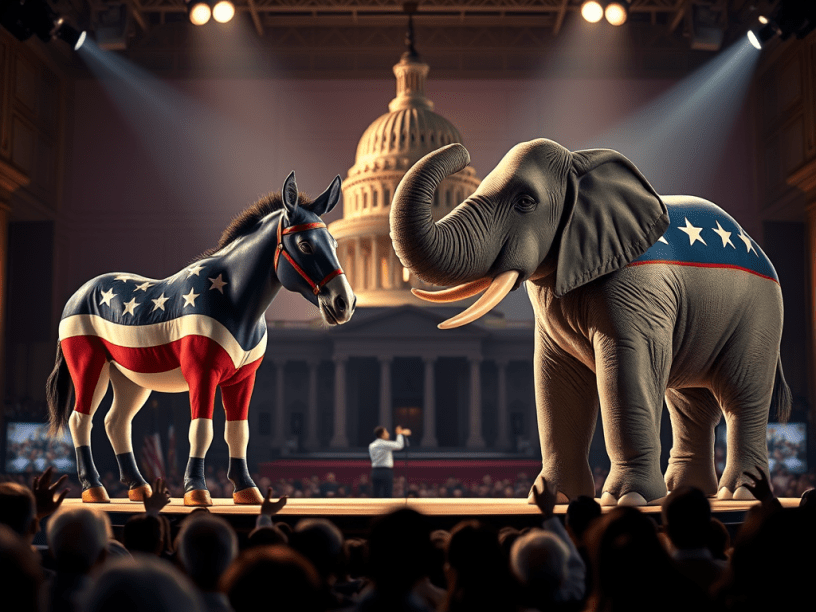
Competition: The Engine of Integrity
Competition is what keeps human endeavor sharp. Whether it’s in business, science, or politics, rivalries push people to work harder, innovate more, and deliver better results. When competition disappears, so does the drive to improve.
Think about monopolies. For decades, AT&T—nicknamed “Ma Bell”—dominated telephone service in America. Consumers had no real alternative. The result? Exorbitant rates, clunky technology, and customer service so bad it was a punchline. People put up with it because they had no choice. Only when the monopoly was broken apart in the 1980s did prices drop, service improve, and innovation accelerate.
The principle is timeless: if you’re the only provider, you can get lazy, dishonest, or downright abusive—and people will tolerate it because they have no other option. Competition forces accountability.
The Framers and the Value of Party Competition
The Founding Fathers didn’t sit down and say, “Let’s create Democrats and Republicans.” In fact, many of them dreaded the rise of political factions. George Washington warned in his 1796 Farewell Address:
“The alternate domination of one faction over another, sharpened by the spirit of revenge, … is itself a frightful despotism. But this leads at length to a more formal and permanent despotism.”
Yet Washington’s fears proved unrealistic. Human nature guarantees factions. People group together around ideas, interests, and ambitions. And while factions can be messy, they also serve a crucial purpose: they check each other’s excesses.
James Madison, in Federalist No. 10, wrote that the multiplicity of factions in a large republic would prevent any one from seizing unchecked control:
“A zeal for different opinions concerning religion, concerning government, and many other points, … have, in turn, divided mankind into parties, inflamed them with mutual animosity, and rendered them much more disposed to vex and oppress each other than to co-operate for their common good.”
Alexander Hamilton, in Federalist No. 1, was blunt about the emerging partisan divide:
“To judge from the conduct of the opposite parties, … they will mutually hope to evince the justness of their opinions by the bitterness of their invectives.”
In other words, the Founders saw that parties would arise whether they wanted them or not. Once they did, each party became a watchdog against the other. Only a Democrat calls out a Republican’s corruption. Only a Republican exposes a Democrat’s incompetence. It’s not always noble, but it works. Each side polices the other because doing so serves their own interest—and, in the process, the public benefits.
Why Competition in Politics Matters
The genius of a two-party system isn’t perfection. It’s pressure. When one party slips into arrogance, waste, or corruption, the other party pounces. That rivalry creates an incentive to stay relatively clean and to respond to the needs of the people.
The presence of two viable parties keeps the playing field honest. Even if you dislike both sides, their very existence keeps each other from consolidating unchecked power.
When competition disappears, however, the problems are the same as with monopolies in business: stagnation, corruption, and contempt for the consumer—or, in politics, the citizen.
Idaho: A One-Party State
Nowhere is this more evident than in Idaho. For generations, Idaho has functioned essentially as a one-party state. Republicans dominate nearly every statewide office, most legislative seats, and a majority of local governments. Democrats haven’t held the governor’s mansion since 1995, and their presence in the state legislature is so small that it barely registers.
What happens when one party reigns unopposed?
- Corruption goes unchecked. If the only meaningful contests are in Republican primaries, there’s little incentive to hold leaders accountable. Party loyalty trumps integrity.
- Innovation stalls. With no opposition pushing new ideas or challenging stale policies, lawmakers recycle the same solutions—or avoid solving problems altogether.
- Judicial and regulatory capture. Courts, commissions, and bureaucracies are filled with people aligned to the dominant party. Without balance, oversight is weak, and favoritism thrives.
- Voter apathy grows. Many citizens assume their vote doesn’t matter. When outcomes are foregone conclusions, participation declines, further entrenching the status quo.
This isn’t a partisan gripe. It’s a structural one. The same dangers would apply if Democrats held every lever of power in Idaho. Any single-party system breeds arrogance, secrecy, and abuse.
Idaho’s Ethics Problem
Idaho’s government has long ranked among the worst in the nation for transparency and accountability. In 2015, the Center for Public Integrity gave Idaho a D-grade for state integrity. The report cited weak disclosure laws, a lack of independent oversight, and ineffective ethics enforcement. Lawmakers essentially police themselves.
That’s not a coincidence. It’s what happens in a one-party environment. With no strong opposition to expose scandals, the ruling party has little incentive to create strong ethics structures. The foxes guard the hen-house.
The Courts: Public Distrust Runs Deep
The problem isn’t limited to elected officials. Idaho’s court system has also earned a reputation for bias, favoritism, and corruption. Citizens often feel that justice is predetermined, and many believe the judiciary serves political masters rather than the rule of law.
Here are just a few snippets from Idaho citizens venting online:
- “Kootenai County corrupt court system … I have been falsely arrested and when I wrote the judge … proved my timeline … no justice.” — Reddit
- “How could Idaho be most at risk for corruption … a body which regulates corruption simply gets an advantage to being corrupt.” — Reddit
Whether every claim is true is beside the point. What matters is perception—and that perception is widespread. Large numbers of Idahoans believe their courts are not neutral arbiters of justice but extensions of entrenched political power.
Competition as the Antidote
So why do we have a two-party system? Not because it’s flawless, but because it disciplines power. It ensures that corruption gets called out, incompetence gets exposed, and voters have at least one alternative.
Idaho’s problem is not that Republicans are inherently corrupt. The problem is that unchecked power inevitably breeds corruption, regardless of party. The Founders understood that human nature requires checks and balances. Two parties fighting it out may not be elegant, but it prevents one group from owning the system outright.
Until Idaho fosters real political competition, its government and courts will remain plagued by arrogance and opacity. Citizens will continue to distrust the system, and deservedly so.
Conclusion: Time to Break the Monopoly
We all know what happens when monopolies go unchecked—Ma Bell taught us that lesson. Idaho’s one-party monopoly on politics has produced the same results: high costs, low quality, and no accountability.
If we want an honest judiciary, transparent governance, and a state where public trust is restored, we need real competition in the arena of ideas and candidates. I don’t believe the Democrats are the solution, but the Republican Party needs competition. Until then, Idaho will remain what it is today: a case study in why one-party states fail their people.
 Idaho judicial reform