
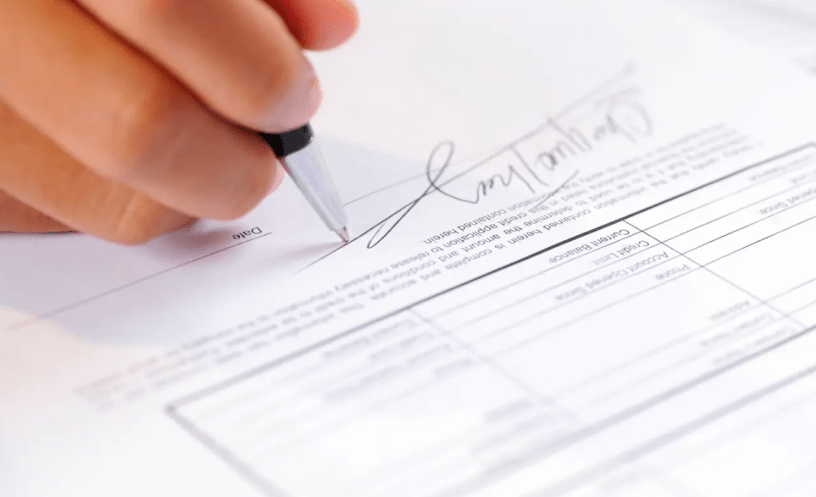
The Importance of a Date Line
In nearly every aspect of life, dates matter. They are not mere formalities — they are the markers that establish legitimacy, sequence, and fairness.
Think about it:
- A test must be taken before the answers are given. A student can’t fill in a test answer sheet weeks later, after the grading key is published.
- A construction estimate must be dated before the work is done, so both parties know what costs were anticipated. You can’t draft an “estimate” once the invoices have already been paid.
- A business contract has force because it is tied to the conditions at the time it was signed. If lumber costs double after a contract is executed, the supplier can’t retroactively backdate a new agreement to capture the higher price.
Without reliable dates, every agreement, transaction, and obligation would be subject to manipulation.
Governing Boards: Authority in Time
This principle is even more critical in government and corporate governance.
Take Congress: the 118th Congress (2023–2024) has adjourned. Its members cannot reconvene in 2025 and backdate a bill as though they had passed it when they still held power. Authority only exists while the body lawfully exists.
Or consider a city council. Even if every member unanimously agrees today that they “should have” appropriated funds for a park five years ago, they cannot retroactively create a resolution and backdate it to 2019. Their authority ended with their term.
The same applies to corporate boards. Directors only have power while they lawfully serve. If a board disbands, dissolves, or fails to meet quorum, it cannot later reconstitute itself on paper and create resolutions dated during its prior tenure. To allow otherwise would be to invite chaos and fraud.
Binding Agreements Require Contemporaneous Execution
The strength of contracts, resolutions, and minutes lies in their contemporaneous creation. Businesses, governments, and citizens must be able to rely on the premise that a document reflects the reality at the time it was signed.
If agreements could be rewritten later, commerce would collapse. Imagine shareholders in a publicly traded company suddenly producing “resolutions” from five years ago to retroactively alter executive compensation, stock options, or dividends. Such practices would shatter investor confidence and destabilize markets.
That is why the law treats backdated documents with suspicion, if not outright contempt.
Judicial Precedent on Backdated Documents
Courts across the country have been clear: backdating undercuts credibility and legal enforceability.
- Idaho Supreme Court, Farmers Nat’l Bank v. Shirey (1994): The Court stressed that documents created after the fact, without proper procedure, cannot establish undisputed facts in summary judgment proceedings.
- U.S. Supreme Court, Celotex v. Catrett (1986): While focused on summary judgment, the Court emphasized the moving party must show an absence of genuine factual dispute. Backdated or self-serving documents create disputes, not resolve them.
- Other States: Courts routinely strike down backdated contracts and minutes. For example, in Arroyo v. Jones (California, 2002), the court held that retroactive board resolutions carried “no legal force where not contemporaneously adopted.”
The reasoning is consistent: legitimacy depends on contemporaneity.
The Canyon County Example
Yet in a recent Canyon County case (No. CV14-25-06656), Judge Thomas Whitney accepted backdated documents as legitimate evidence in support of summary judgment.
During the September 12th hearing, defense counsel admitted:
“There’s absolutely nothing improper about backdating a resolution or preparing a resolution that refers to an act that took place earlier.”- September 12 Hearing
Rather than rejecting this reasoning, Judge Whitney proceeded to treat the disputed documents — unsigned, unverified, or backdated — as sufficient to grant summary judgment. This despite the plaintiff’s detailed opposition pointing out that:
- The alleged April 24, 2025 board meeting lacked contemporaneous minutes.
- The only records were self-serving exhibits drafted later.
- No emails, verified notices, or authenticating signatures corroborated the supposed board actions
By granting summary judgment under these conditions, Judge Whitney effectively allowed disputed, backdated documents to override live factual disputes.
D-Grade for Integrity
This is precisely the type of conduct that led the Center for Public Integrity to give Idaho a D-grade for state integrity, and why the Better Government Association has consistently ranked Idaho near the bottom for ethics and transparency.
When judges accept backdated paperwork as legitimate proof, they undermine the reliability of every agreement in Idaho — from small-town contracts to corporate governance.
If this precedent holds, what stops any group from drafting one-sided resolutions years after their authority has ended, then waving them in court as binding? The result would be chaos. Governance requires integrity, and integrity requires contemporaneous, verifiable records.
Idaho deserves better than a D-grade. It deserves courts that apply the law evenhandedly and reject the dangerous shortcut of backdated documents.
 Idaho judicial reform